Consenter purposes
For which purposes can you ask your users for their consent in Consenter?
You do not need consent from your users for all your processing purposes. Nor do all website operators need to process data for all possible purposes. Below you will find a list of the most important purposes for which website operators require consent from their users. In the configurator we provide, the Consenter Manager, you can select the purposes for which you need to process your visitors' data.
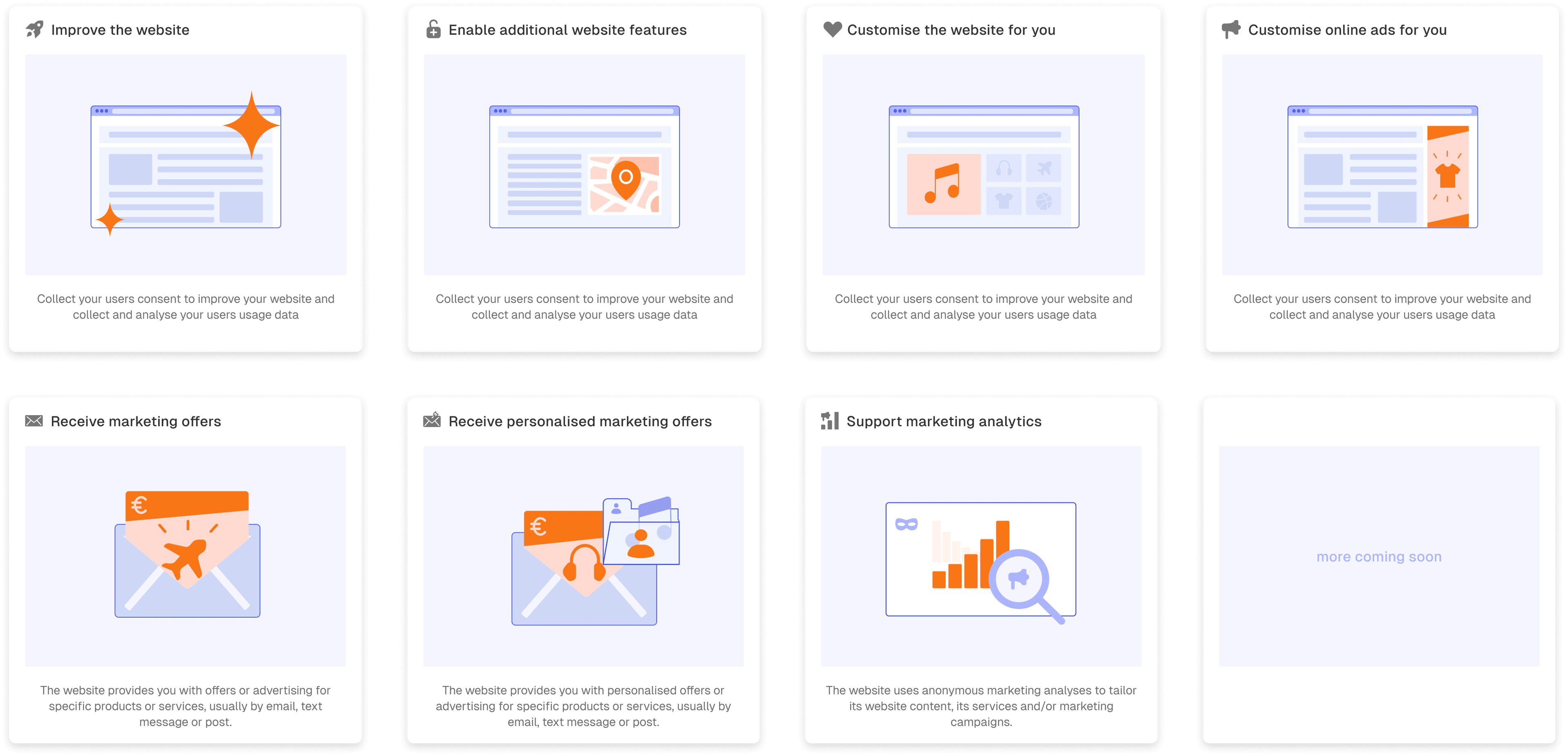
What purposes should you select?
Depending on your interest and the processing activities you perform, you should select the appropriate purposes for your case.
💡 Choose only the purposes you actually need
This keeps your consent requests simple, avoids tiring your users, and helps you stay on the free or cheaper plan.
Since there are different ways to combine the purposes that can be selected in Consenter, we provide you with a brief indication. There are basically three categories of possible purpose combinations.
1. Alternative purposes
There are purposes in Consenter between which you should choose, i.e. they are mutually exclusive. With these purposes, it does not make sense to combine them because one purpose encompasses the other, only slightly expanding its functional scope, and changing the risks and consent rates.
Choose one purpose within this bucket # 1:

Least functionality; least risk; but no consent required

Medium functionality; medium risk; consent required, but high consent rate

Broadest functionality; higher risk; consent required, still pretty good consent rate
Choose one purpose within this bucket # 2:

Basic functionality; medium risk; medium consent rate

More functionality; higher risk; lower consent rate
In both buckets, each subsequent purpose encompasses the preceding one. The first purposes do not require consent or at least have a very high consent rate. On the other hand, the technical scope of functions only increases marginally with each subsequent purpose. Because of the minor differences, you should decide which purpose best meets your needs.
2. Ambiguous combinations
There are also purposes where one expands the scope of the other, and where you could therefore select the broader purpose as the only one, but the functional scope, risks and consent rates for the purposes vary more significantly. This means that you can either choose only the broader purpose to avoid consent fatigue for your users, or choose both purposes to maximise your benefits.
Below, we list the buckets in which you have to make such a strategic decision. Take your choice according to the following parameters:
- Select only the broader purpose → less consent fatigue for your end users → the broader purpose goes with a lower consent rate, however, it has more functionalities
- Ask for both → get limited functionalities with a higher consent rate AND → get more functionalities with a lower consent rate → however, keeping both purposes means more consent fatigue for your end users
Weigh up these pros and cons in this bucket # 3:
Basic functionality; low risk; pretty good consent rate

Much more functionality; high risk; low consent rate
Weigh up the pros and cons in this bucket # 4:
Basic functionality; low risk, high consent rate

Personalise the website for you (i.e. personalisation of the website does not fall under marketing)
Much more functionality, higher risk; lower consent rate
Weigh up the pros and cons in this bucket # 5:
Basic functionality; low risk; pretty good consent rate
Personalise the website for you (i.e. personalisation of the website falls under marketing, e.g. in the case of a web-shop)
Much more functionality, high risk; low consent rate
3. Combinable purposes
Of course, there are also purposes whose functional scope does not overlap and which can therefore be combined in a meaningful way. They complement each other. However, since some of the purposes are alternative or ambiguous purpose combinations (see above), there are various dependencies when combining all purposes with each other.
The following list therefore provides an overview of all purpose combinations. The purposes listed within a bucket are those where you must choose or make a strategic decision. The purpose selected in each bucket can then be combined bucket by bucket without further ado:
Bucket # 1
Bucket – extra

Bucket # 2
Bucket # 3
Buckets # 4 and 5
Can be combined with one of the following purposes (see bucket # 1):
Basic functionality; low risk; pretty good consent rate
Why can't you formulate your own purposes in Consenter?
To ensure transparency and consistency for end-users, you cannot define your own purposes but must choose from our predefined list.
Attention: You cannot customize the purposes, but your processing operations!
Important: The purposes we provide are standardized and final. This means that you cannot change these purpose formulations or add new purposes. The reason for this is that this is the only way we can guarantee
- that users understand the purposes,
- that the correct benefits and risks are assigned to each purpose,
- and that all your purposes are specified in accordance with the GDPR.
However, we have specified and standardized the purposes in such a flexible manner that, in the vast majority of cases, you will be able to categorize your various processing operations under one purpose or another.
More important: We enable you to configure the technologies, which you get from third-party providers to process your end-users' data for one or another purpose, in a way that minimizes the risks for your end-users. In your Consenter Manager, you can configure your Consenter Banner accordingly and, eventually, communicate the achieved high level of data protection to your end-users. Doing so, you can maximize the trust of your end-users and, thus, the consent rate (without having to leave your end-users in the dark about the risks or manipulate them into giving their consent). Learn more →
For which purposes should you use contextual consent and for which consent in a banner?
For some purposes, it is better not to use a cookie banner to ask for your users' consent when they enter your website, but only later when they are engaging with specific content of your website. This applies in particular to additional website features that you integrate for a better user experience, such as maps, videos and social media feeds. The reason for this is that your users will better understand the significance of giving their consent if you ask for it directly in the context of using a feature that requires consent. See TPP integration guide →
How is this guide?
Last updated on